EnergyFM is a family of
domain-specific Time Series Foundation Models (TSFMs) for smart energy meter analytics. Built upon
the Tiny Time Mixer (TTM) and TSPulse architectures, we introduce
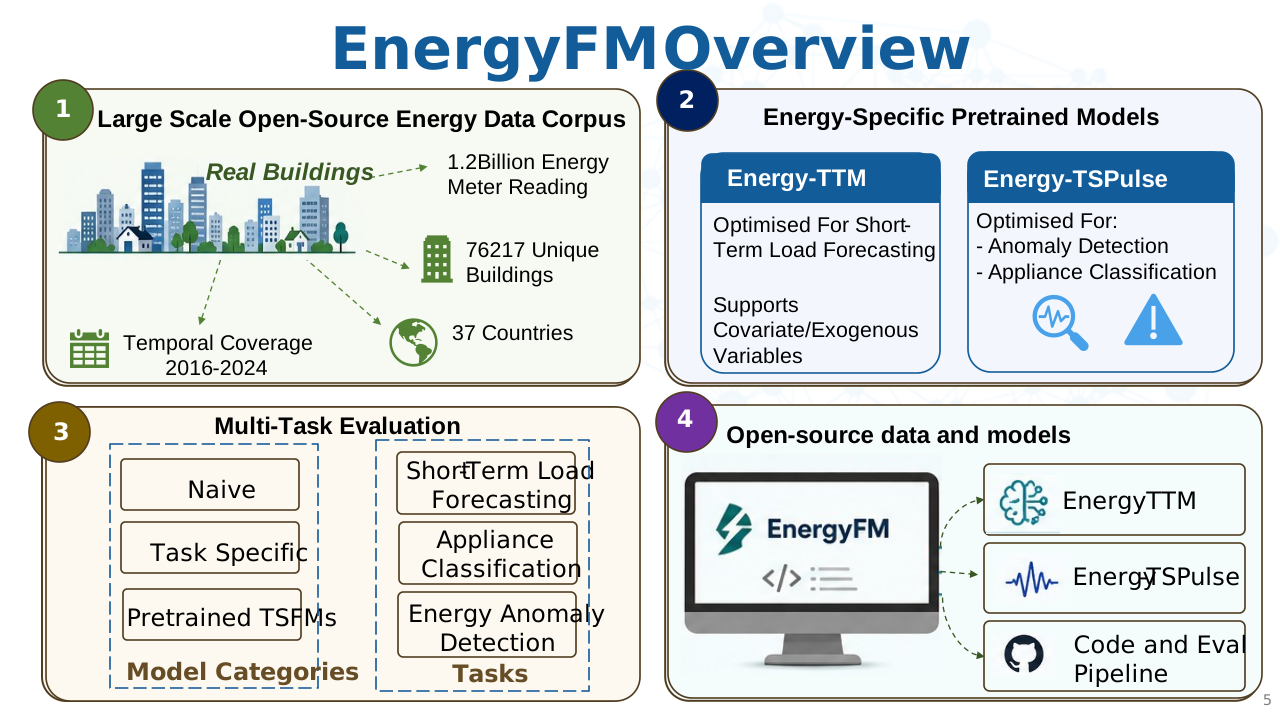
two pre-trained foundation models Energy-TTM and
Energy-TSPulse designed specifically for energy meter data.
EnergyFM
supports multiple downstream tasks, including load forecasting, anomaly
detection, and appliance classification. The models are pre-trained on
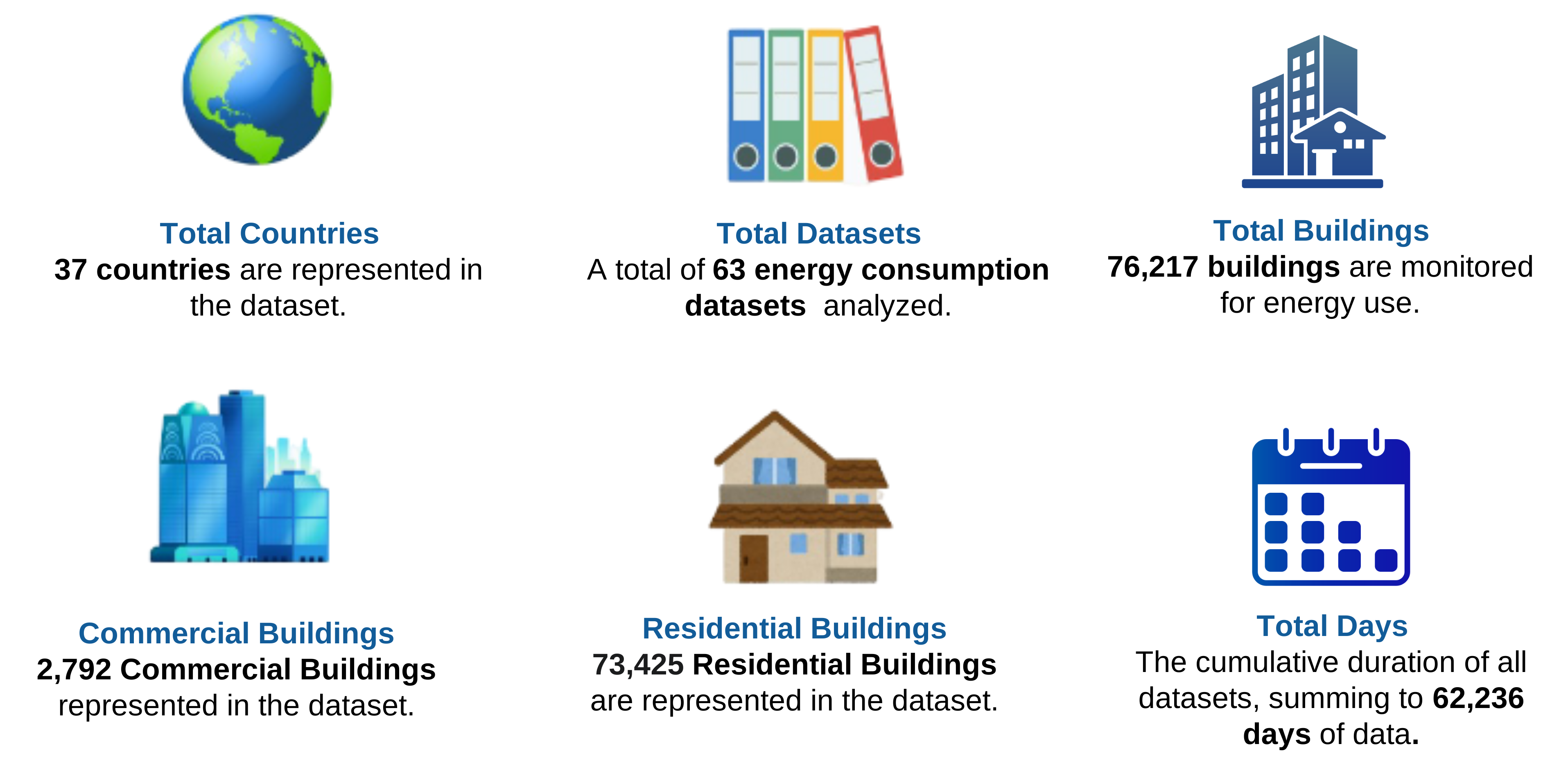
1.26 billion hourly smart meter readings from 76,217 commercial
and residential buildings spanning multiple countries, climate zones, and building types.
By learning rich representations of energy consumption through self-supervised learning, EnergyFM
achieves state-of-the-art or competitive performance in both zero-shot and
fine-tuning settings, providing a scalable foundation for next-generation energy
analytics.
Large-scale smart meter repository used for pretraining and benchmarking.
EnergyFM is evaluated across three downstream tasks on both in-distribution (ID) and out-of-distribution (OOD) building splits to assess generalization under zero-shot and fine-tuning settings.
Models are evaluated using the standard 168-hour context → 24-hour prediction setup. Forecasting performance is reported using NRMSE.
Table 1. Comparative forecasting split monitoring OOD vs ID absolute errors.
Models are evaluated on the LEAD 1.0 benchmark following the official evaluation protocol. Performance is measured using Precision, Recall, and Macro F1-score.
Table 2. Precision, Recall, and F1 performance indices for outlier classification.
Appliance ownership prediction is formulated as a time-series classification task using hourly smart meter readings. Performance is reported using Precision, Recall, and Macro F1-score.
Table 3. Downstream tier ratings for structural home appliance identification.
Finding 1.
Domain-Specific Pretraining.
Pretraining on large-scale energy meter data consistently
improves downstream performance over general-purpose time series foundation models across diverse
energy analytics tasks.
Finding 2.
Strong Zero-Shot Generalization.
Energy-TTM achieves competitive forecasting performance
on previously unseen buildings without task-specific fine-tuning, demonstrating strong
transferability across domains.
Finding 3.
Unified Energy Representations.
Energy-TSPulse learns transferable temporal
representations that support multiple downstream tasks, including anomaly detection, appliance
classification, and missing value imputation.
Multiple pre-trained variants optimized for different datasets and downstream applications. All checkpoints are available as branches on Hugging Face.
@inproceedings{energyfm2026,
author = {Arjunan, Pandarasamy and Srivastava, Naman and Kumar, Kajeeth and Jati, Arindam and Ekambaram, Vijay and Dayama, Pankaj},
title = {EnergyFM: Pretrained Models for Energy Meter Data Analytics},
year = {2026},
url = {https://doi.org/10.1145/3744255.3798119},
doi = {10.1145/3744255.3798119},
booktitle = {Proceedings of the 17th ACM International Conference on Future and Sustainable Energy Systems},
pages = {556–568},
series = {E-Energy '26}
}